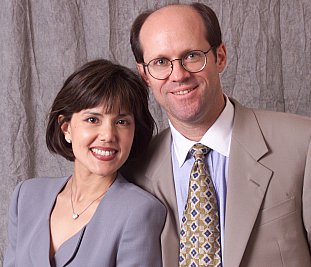
 Steven and
Michele Kirsch Foundation
Steven and
Michele Kirsch Foundation
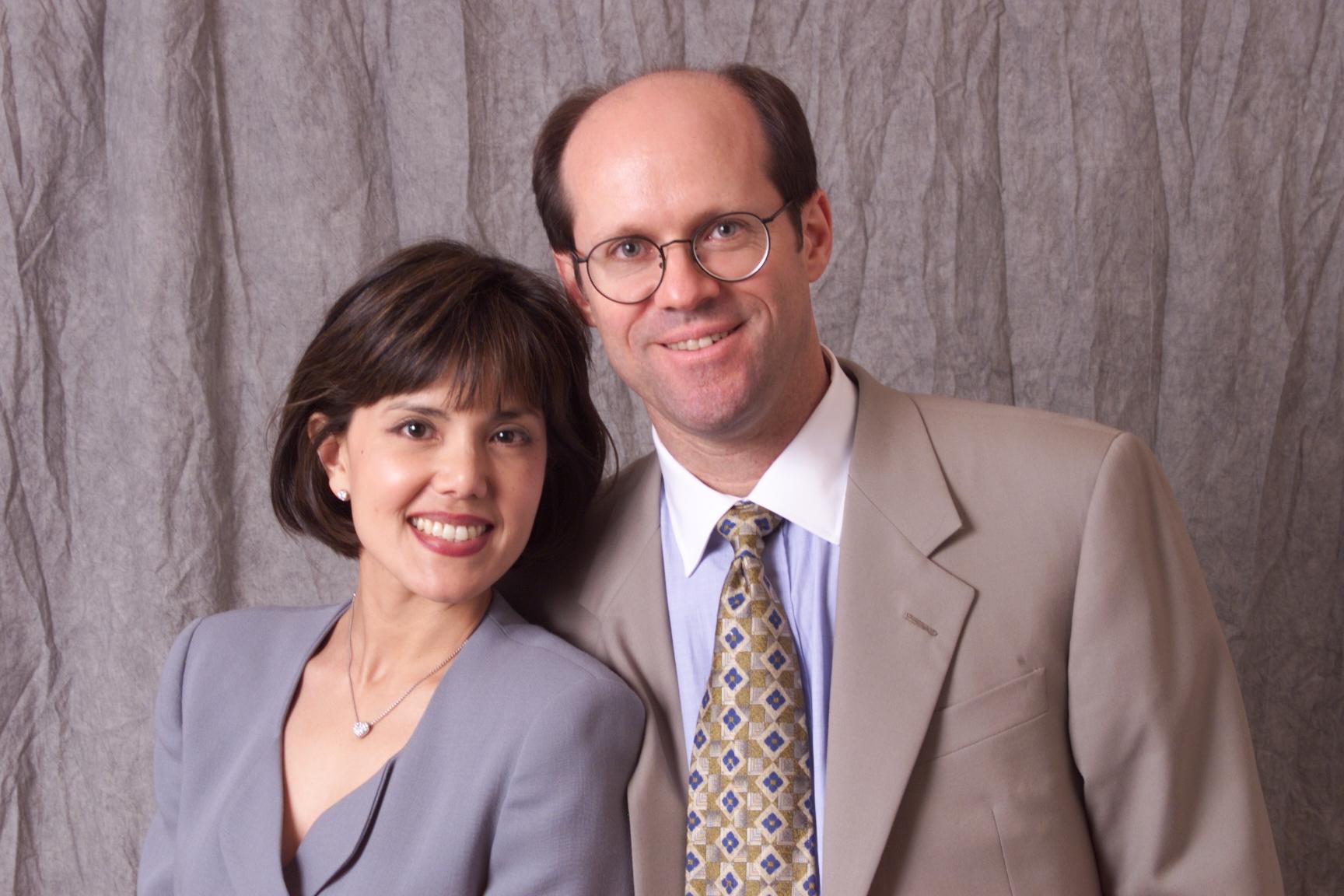
This is our old site. Please check out our new site at www.kirschfoundation.org.
We maintain a $75 million charitable fund at the Community Foundation of Silicon Valley (CFSV). We donate $5M a year to a relatively small number of worthwhile causes where we can make a significant impact, mostly in the medical area. In 1998, we donated $5.7M to a variety of charitable causes. Recently, we were named "1999 Outstanding Philanthropists" by the Silicon Valley chapter of the National Society of Fund Raising Executives.
To apply for funding, please see our How to Apply for Funding document.
To learn why we donate, read on, or see reasons as to why we give or why excuses for not giving are full of holes. Or why you don't want to give anonymously. You may also want to check out this short PowerPoint presentation about the why, how, and where of charitable giving. Or how we are different than most other foundations. Want to know the one question that we ask ourselves all the time, but that nobody asks us?
Why do we give?
We give in order to make a positive difference in our lives and the lives of people we
care about.
A recent article in the Los Altos Town Crier provides an excellent overview of our giving.
You hear a lot about "venture philanthropy" nowadays. We don't believe you can quantify the results of charitable giving in most cases. So we have a rather unique and different vision of what venture philanthropy means to us.
Our goalsBecause Michele is in law school and is otherwise a full time mom, and because I have a full time job and like to spend as much time as I can with our kids, it really cuts into the amount of time we have for philanthropy. So we picked a few easy goals that we can accomplish in our spare time. These goals include:
- Saving the world (through our support of asteroid identification, support of nuclear disarmament organizations such as Ploughshares, and through supporting the CTBT via direct contact with Senators, Senate candidates, and Presidential candidates, as well as publicly raising awareness in on my website, talks, in the press, and with industry trade groups such as SVMG)
- Curing major diseases (such as cancer and diabetes through our investment in Targesome and sponsoring of a variety of prominent research scientists at leading universities)
- Cleaning up the air in California (through our support of EVs in advertisements and interviews, our everyday use of our two EVs, financial support of solar vehicle research, our work in passing AB71, and future EV incentive legislation we are sponsoring. Wouldn't it be nice if we taxed polluting vehicles during registration and passed on that tax to non-polluting vehicles? Driving a clean EV would cost way less than a gas vehicle since it would be subsidized by polluting vehicles. That would lead to an enormous adoption of EVs. I have a clever idea for an initiative that will clean up the air in California.)
- Reforming politics (the rejection of the CTBT by the Senate, clearly pointed out the need for political reform to us. In talking with many people, the consensus is that the place to start is campaign finance reform. Others, such as Bill Moyers and Norman Lear have realized this long before we did. The basic strategy we all are pursuing is is starting by reforming campaign finance, starting at the state level. Public Campaign's (Ellen S. Miller) Clean Money Campaign Reform proposal, which is strongly backed by Bill Moyers, seems to be the best workable solution so far; it has been passed in several states and was recently (November 16, 1999) upheld as constitutional. We'd also like to see a candidate that supports the CTBT and the environment get elected President. And for Congress to pass a line-item veto ability for the President that is not invalidated by the Supreme Court like the last one (this can be done). And it's about time to pay our UN dues which we haven't paid for almost 20 years now. Steve also has some personal political goals he'd like to accomplish.
- Reforming public education (60 Minutes ran a story on Nov 14, 1999 which pointed out a lot of the problems with our public education system. In talking with a former public school principal, it appears there are only a few things to change that would make a dramatic difference in the quality of our public education system. The good news is you only have to make a few changes. The bad news is that these are not so easy to change.)
- Making government more efficient by changing it to work more like a for-profit company
- A complete ban on hand guns (like they have in the UK; if it works there, why can't it work here?)
- Support for our local community (such as our support of a number of arts organizations, the Tech Museum, and many more)
- Encouraging others to give (through press interviews, talks, events at our home, emails, and SV2)
- Making it illegal to send unsolicited mass promotional FAXes and e-mails
We also support a bunch of other environmental, educational, and local causes.
So we’ve left some of the really tough and important causes, like eliminating daytime talk shows (except on ABC, of course) and bad website design, to those with more time.
Want to help save the world? You can make a difference. See my page on the CTBT.
"An ounce of prevention is worth a pound of cure"
Our goal is to make the world a better place primarily by focusing on leveragable
activities. For example, we're more interested in funding research on finding a cure for
cancer than in sponsoring organizations that help people with cancer.
The most satisfying experiences are when we set an ambitious and measurable goal and achieve it. Moreso if no one else (or few others) is doing it, it has an impact on millions of people, and our efforts were key to either launching the project or getting it done or both. For example, our Targesome donation to cure cancer fits this to a tee, NEOS funding (to identify Near Earth ObjectS that could collide with the Earth) fits the bill here, as do our efforts that resulted in the creation of a higher return investment option at the CFSV. Contributing to more "traditional" causes such as the American Cancer Society, while worthwhile, is less interesting to us.
We donate both time as well as money. For example, I have served as captain and coach for the Computer Museum Computer Bowl fundraisers, helped fundraise, hosted events, and sits on 6 non-profit boards (listed on Steve's home page)...well, actually 7 non-profits if you count Infoseek! Michele volunteers on various committees; she is chairing the Leadership Committee of the Tech Museum, for example. We also drive an EV1 (it's better not to pollute the environment in the first place than to pay later to clean it up).
There are three main "secrets" to successful giving:
1) First you must decide which type of person you are:
- PROACTIVE: you have found value in giving and want to give and are always looking for opportunities to give in the areas that you have decided are important to you in order to achieve a set of goals, or
- REACTIVE: you are not actively looking to give; you are either too busy ("it's not a priority for me now"), or you spend time determining whether to give and how much to give as opportunities arise
2) If you decide you are going to be proactive about giving, set up an endowment fund at a community foundation. You make one donation and then can donate from that fund for the rest of your life. It makes giving easy and painless and fun. Here are some details on charitable foundation options which explains why you never want to donate directly to charities.
3) Pick causes you believe in and want to do something about. The best way I've found to find a cause is simply to let it find you. You'll experience, hear about, or read about something that you think is not right and that someone should fix. If you feel passionately about the cause, then make it your own. It could be something as simple as "someone should do something about the long wait times in the Emergency Room at the local hospital" or something as complicated as fixing our political system.
Another reason we give while we are young is that, among other things, there are no tax advantages of giving after you are dead. And you give it all away a few years before you die, you don't have time to enjoy the benefits of your giving or to see the impact it is making. So starting to give at a young age allows us to make a difference sooner. For example, giving to cure cancer, cure AIDS, or identify asteroids makes a lot more sense now, than in 50 years from now when we're either dying from cancer, or we just got hit by an asteroid that wiped out all life on earth!
And you don't have to be altruistic about your giving either. If Congress passes a 5 year moratorium on cloning research, that means that research that would make the quality of our lives in our old age, is going to be delayed by 5 years; and a potential discovery that might help us might be discovered 5 years too late; all because we failed to take action when we were younger. My mom, like a lot of folks, suffers from macular degeneration. If we start giving now to promising research in this area, there's a chance that there may be a cure or treatment in 20 years when it might be affecting our vision! My dad suffers from type I diabetes. Same story there. It's just a lot more effective to give now than later. I wish a lot more people who are wealthy would realize this (in fact, one of my projects is try to educate my colleagues of this).
After all, it turns out that most things in life are really not that expensive. So we try to be as aggressive as we can giving away money now, but not so much that we run out of money to give later on. In fact, the main reason we don't give it all to charity right now is that we are leveraging the money more effectively now than we could in a foundation (i.e., much higher return on investment). The bottom line is a higher lifetime donation to charity; the tradeoff being that we can't give as much now as we would like.
There are many more reasons as to why we
give and how we evaluate different causes. If you're already convinced, and can't
wait, here's how to get started.
Here are some of the areas we are currently interested in:
Ratification of the Comprehensive Test Ban Treaty (CTBT)
The CTBT was concluded in 1996 after 40 years of bipartisan effort. The United States was
the first to sign. President Clinton called it ''the longest-sought, hardest-fought prize
in the history of arms control.''
We think that this is the most important vote that the US Senate will ever make in our lifetime. It was rejected after only 3 days of debate by a vote that, with few exceptions, was totally partisan. Virtually all Senate Republicans voted against ratification, despite the fact that this is a completely non-partisan issue and is supported by 80% of Republicans.
We think the Senate rejection of the CTBT vote was a national embarrassment. We encourage you to make up your own mind about this critical issue and decide who you will support for Senators and for President. And I hope that you will encourage your friends to do the same. Bush is against ratification of the treaty, Bradley is for it.
Here's some background on the CTBT to help you
decide.
Impacting Education
There are lots of things wrong with our
public education system. Edison Schools looks like a great alternative.
We are also funding development of programs that teach people skills (that is, "interpersonal skills") to undergraduates. This is a ridiculous shortcoming of our educational system. Mastery of soft people skills can have dramatic impact on one's career. Educational institutions such as MIT are great at turning out individual contributors and do little to develop "people skills". I'm currently working with MIT on this and there have only recently been a couple of promising new programs in this area.
We also recently donated $2.5M to help fund the new
Computer Science building complex at MIT and $100K to help fund the restart of Technology
Review. We've also made a major contribution to Mills College where Michele went to
school.
Improving the Environment
We are long time supporters of NRDC and the Sierra Club Legal Defense Fund, as well as
other environmental organizations such as the San Francisco based Resource Renewal
Institute.
My wife recently won a free lease on GM's new EV1 and we've paid to extend the lease
another year. These are pretty hot little cars, and they'll be even more practical once
the NiMH batteries are available in 1999. I drive my (very expensive and very cool) Acura
NSX a lot less in favor of the EV1 because of the positive environmental impact. It turns
out that a lot of people would be seriously interested in leasing electric vehicles if
they were allowed in carpool lanes. It turns out the Arizona passed a law that allows ZEVs
in HOV lanes, but California hasn't. I was instrumental in fixing this. I sent hundreds of
emails, met with leading Senators and Assemblymembers, and even the Governor.
AB 71, introduced by Assemblymember Jim Cunneen (R-Cupertino), gives ILEVs, including EVs, access to California’s HOV lanes, regardless of occupancy. The bill also directs the DMV to develop a special decal for these vehicles so that they could be easily identified by the CHP.
Now that we've addressed compensating for the inconveniences of EVs, we must next
attack the cost. The next piece of legislation that we are working on now would give a tax
credit to EV owners. We are also working on getting free parking for EVs in San Jose and
San Francisco, including at the airports. Little things like these can really help raise
visibility for clean air vehicles. EVs are 100 times cleaner than gas cars, even when you
account for power plant generation emissions. Here are some
things we should do to promote ZEVs.
Saving the World
A recent
issue of Time, pointed out that 90% of the asteroids that could devastate Earth have
not been identified. With an extra $1M/year in funding, we could identify all NEOS (as
they are called) in 10 years. Sure the chances are really slim that we are going to be hit
soon. But they aren't zero.
Although at present there is no asteroid KNOWN to be on a collision course with Earth, the probability of an unknown asteroid larger than 1 km in diameter hitting in any one year is estimated by Dr. Paul Chodas of JPL as 1 in 100,000. That makes it more likely that you'll get hit by an asteroid next year than it is that you'll win the lottery or be diagnosed with many deadly diseases.
The cost/benefit of such a donation is enormous. What's the value of a human life? A New York jury recently awarded $150K to $215K each to 13 passengers for 28 secs of turbulence on an American Airlines flight. So clearly a whole life must be worth a lot more than 28 seconds of inconvenience.
Let's assume a life is worth a cool $1M. There are 6B people on the planet and we'll say that half will die shortly after impact. It won’t be a picnic for the other half who survive either, but we don't even have to go there. So a one-time $20M investment saves 3B lives with a 1/100,000 chance every year.
In other words, a single $20M grant saves a mathematically expected $30B each year. Not just the first year. But $30B each and every year for the next 100,000 years. That's less than the price of one jet. I don't know anything with that kind of return on investment.
And if we get hit without warning, it is literally "game over." $1M a year seems like a small price to pay for "collision insurance". Heck, it isn't much more than I pay for collision on my NSX. If Congress won't fund it, I'll be assembling a group of private individuals who will. I really like this project because it's one of the few things I can donate to that can literally "save the world."
Of course, I think it unlikely Congress with fund it. If we don't get hit, the
Congressman will be criticized for wasting taxpayers money. And if we do get hit, it won't
matter since we'll all probably be dead. So politically, it's a stupid decision to vote
for this since you can't win either way.
Local community
Recent major grants have included $100,000 to the Silicon Valley Arts Fund, $500,000
to the Tech Museum of Innovation, $100,000 to the American Musical Theater of San Jose,
and $200,000 to Santa Clara Country Libraries to fund all the Internet computers in
all the County libraries. We've donated in the past to a variety of other local
organizations including Children's Discovery Museum, The Computer Museum History Center,
OICW, Junior League, Macy's Passport, Silicon Valley Charity Foundation, San
Francisco Library, San Francisco Beautiful, Big Brothers, the Exploratorium, Parents
Helping Parents, Firefighters in the Schools, Monterey Bay Aquarium, Plugged In,
Miramonte Health Services, San Francisco AIDS Foundation, San Francisco Zoo,
Stanford Medical Center, UCSF Medical Center, El Camino Hospital, San Francisco Special
Olympics, KQED, and KTEH.
Occasionally, very simple non-monetary contributions can make a huge economic difference.
A suggestion I made recently to the Community Foundation of Silicon Valley that they allow
donors to invest up to 50% of their funds in a higher return investment is now
implemented, and will, I hope, result in millions of more dollars being available for
grant in the future (so far, it is looking very good).
Health
We support a variety of health related causes including the American Cancer Society,
American Heart Association, March of Dimes, Muscular Dystrophy, Arthritis Foundation,
Leukemia Society, Multiple Sclerosis, Diabetes society, AIDS, Memorial Sloan-Kettering
Cancer Center, The Beeve Foundation (Eye surgical team), the American Red Cross, and so
on. I'm particularly interested in sponsoring innovative research in the area of macular
degeneration (which my mother suffers from along with millions of other people) and type I
diabetes (my Dad has this). There's a real cool non-invasive blood sugar testing device
that is recently available to a few individuals; it is cool since you don't have to prick
yourself. This is the type of thing that I'd like to contribute to at some point in the
future, although at the moment we're focusing our funding on curing the disease, rather
than treatments.
I'm also personally interested in funding research that may lead to a restoration of the hair on my head. I originally didn't think that was possible, but now I'm not so sure. It may happen sooner than I think. There is some really interesting research on hair loss and re-growth being done right now.
Someday, if we can accumulate as much wealth as billionaire Jon Huntsman, we'd love to follow in his footsteps by attacking medical problems in the same way he's attacking cancer which is most impressive. In the meantime, we'll make our contribution by supporting 6 brilliant medical researchers from leading universities every year with 3 year, $540K grants to use at their discretion.
Links
Steve Kirsch home page
Venture Philanthropy: A new definition
How we are different than most other
foundations
Some of our causes
Reforming politics
Supporting the CTBT
How we plan to clean up the air in California
Reforming public
education
Hair loss research
Privatizing government
Aging
Opinions on other issues
Surprising things you should know about medical
research, medical care, and more...
How to apply for funding
How to apply for funding
List of Available Projects
Projects we are pursuing in 1999
Charity projects submitted to us to consider
Information on charitable giving and how to get started
Why, how, and where of charitable giving
(PowerPoint presentation)
Why and where we give, and the criteria we use
to evaluate donations
The best way to give: should you have a
private foundation?
CNBC interview on charitable giving (MPG file; 13.9 Mb; 6
minutes)
Innovative ideas for more effective
charitable giving
Why you shouldn't give all your money
away now
Reasons as to why we give
Why excuses for not giving are full of
holes
Why you don't want to give anonymously
Projects we've funded
Grants we made in 1998
Grants we made in 1999
Targesome donation page
Articles
Giving back a bit
A new
way of giving: Infoseek's Steve Kirsch champions causes: curing cancer, saving the
world
Article on MIT $2.5M gift
Group
Wants The Rich to Donate More - Study found Silicon Valley's elite were stingy toward
charities
Interactive Week:
Some Cyber-Rich Remember to Give Back
Articles on our $1M donation to charities affected by United Way crisis
Please see the links on my home page
Talks
Why, how, and where of charitable giving
NSFRE acceptance speech
Want to help save the world? You can make a difference. See my page on the CTBT.
This is our old site. Please check out our new site at www.kirschfoundation.org